
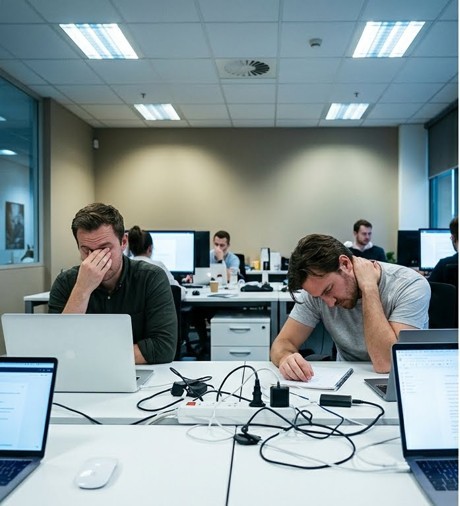
What if leaders are solving the wrong problem?
Most conversations about performance start the same way: a leader reviews the metrics, reflects on themselves, and evaluates their team. They ask:
As Ann Zaslow-Rethaber puts it:
“The difference between a costly turnover and a successful turnaround often comes down to clarity, not urgency… and a willingness to move from ‘Why aren’t they performing?’ to ‘What do they need to succeed?'”
— Ann Zaslow-Rethaber
In my work, I see it constantly. Leaders invest time, energy, and money trying to coach, motivate, support, or replace underperforming team members, only to repeat the same cycle again.
Why? Because the environment itself may be undermining performance.
Research in neuroarchitecture, environmental psychology, and cognitive science continues to show that the design of our environments directly influences stress levels, attention, engagement, and behavior.1
Every space sends signals. Often beneath conscious awareness, the body is constantly scanning its surroundings for cues of safety or threat.
When an environment repeatedly triggers stress responses, even subtly, focus erodes, collaboration declines, and performance suffers.
Yet most workplaces are designed for aesthetics, convenience, or habit, not for how human beings biologically respond to space.
Before assuming the issue is the employee, and before adding more pressure, accountability, or oversight, they assess the environment first.

If you want clarity on what your environment is truly communicating to your team, the Environmental Behavioral Design Assessment reveals it. In 60 to 90 minutes, we identify:
Before deciding someone is underperforming, take a closer look at the environment they are performing in.
My keynotes and workshops engage your audience and teams to take ownership, and further empower them and you.