
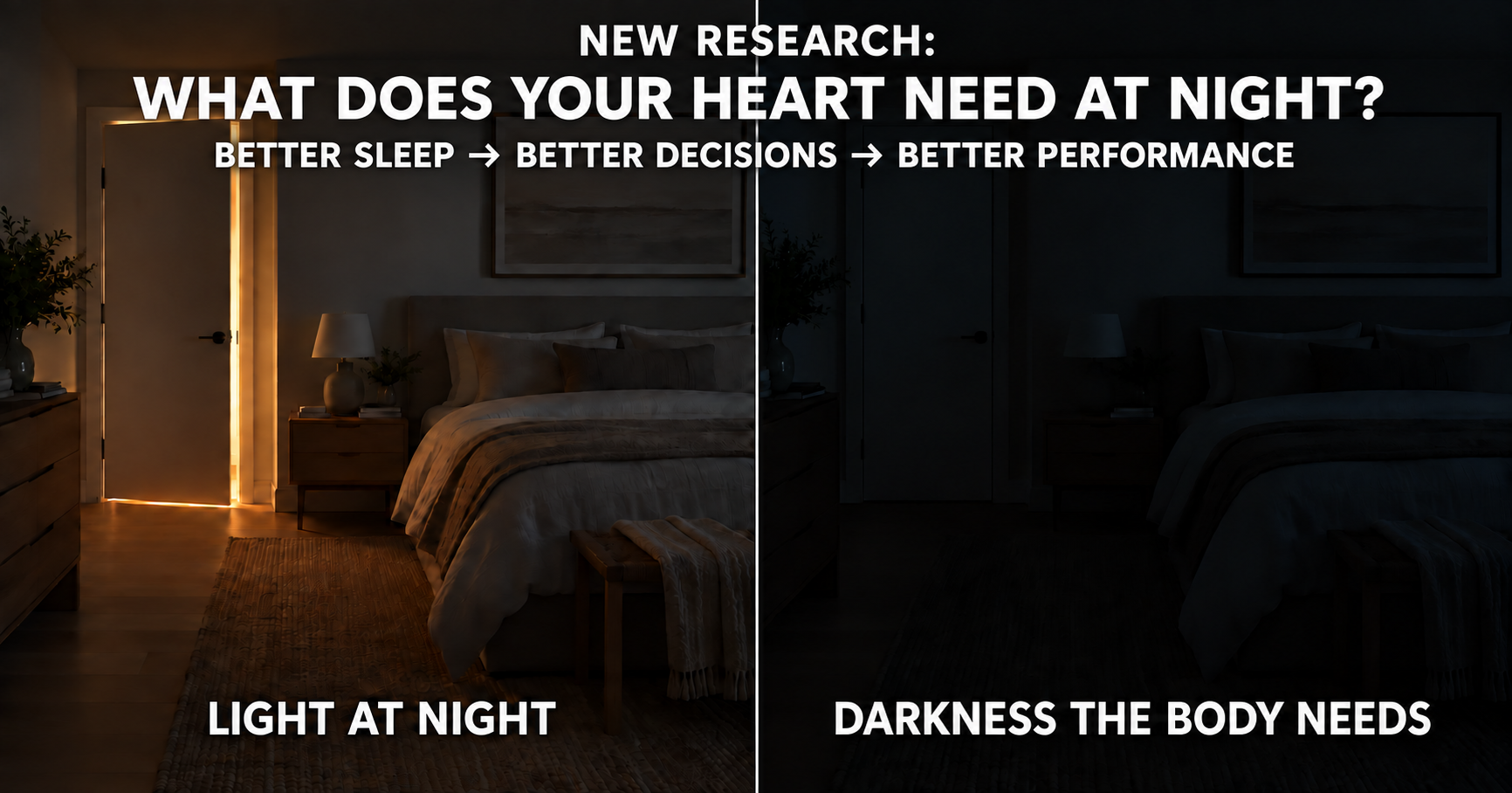
The same bedroom under two nighttime conditions: light spilling through the doorway and darkness at the bed.
For decades, we have understood the human need for properly timed light—and how light drives our bodies and behavior.
Properly timed darkness—the absence of light when the body needs it—is also one of the 16 Human Needs of the Built Environment. This study brings that need into measurable focus.
Restorative sleep supports every human activity, including daytime functioning and the repair and regulation that sustain health and longevity over a lifetime.
A new study examined nighttime light exposure in 11,071 people. Participants wore light sensors at night and later underwent cardiac MRI scans.
Compared with people exposed to almost no nighttime light, those exposed to more than three lux showed changes in the structure and function of the heart, including thickening of the left ventricular wall and early signs of reduced function.
Three lux is roughly the low glow that might reach the bed from a very dim nightlight or light spilling through a doorway—yet it is approximately 1,500 times brighter than a clear, moonless, starlit night.
An association between measured nighttime light exposure and measurable changes in the heart across more than 11,000 people is not something any of us—including architects and designers—can responsibly wave away.
The small design elements add up, day after day and night after night. They shape our bodies and health—for worse or for better.
With so many people struggling with sleep, we need to look at the entire nighttime environment. Light from a hallway, bathroom, electronic device or adjoining room may seem insignificant. But the body that experiences those conditions repeatedly over time is working too hard against the enviornment when proper design can lighten the body’s load.
The nighttime journey needs to be designed as carefully as the daytime experience. People still need to move safely and find what they need, but we can provide that visibility without flooding the bedroom with light.
Shielding light sources, controlling spill and providing true darkness at the bed are part of designing for sleep, recovery and long-term health.
Are we designing nighttime environments that allow the body to sleep, restore and do what it needs to do?
Properly timed darkness is a condition the body needs for restorative sleep, full human health and longevity—even for “youthing” because when we remove stress from the body, it naturally regenerates.